
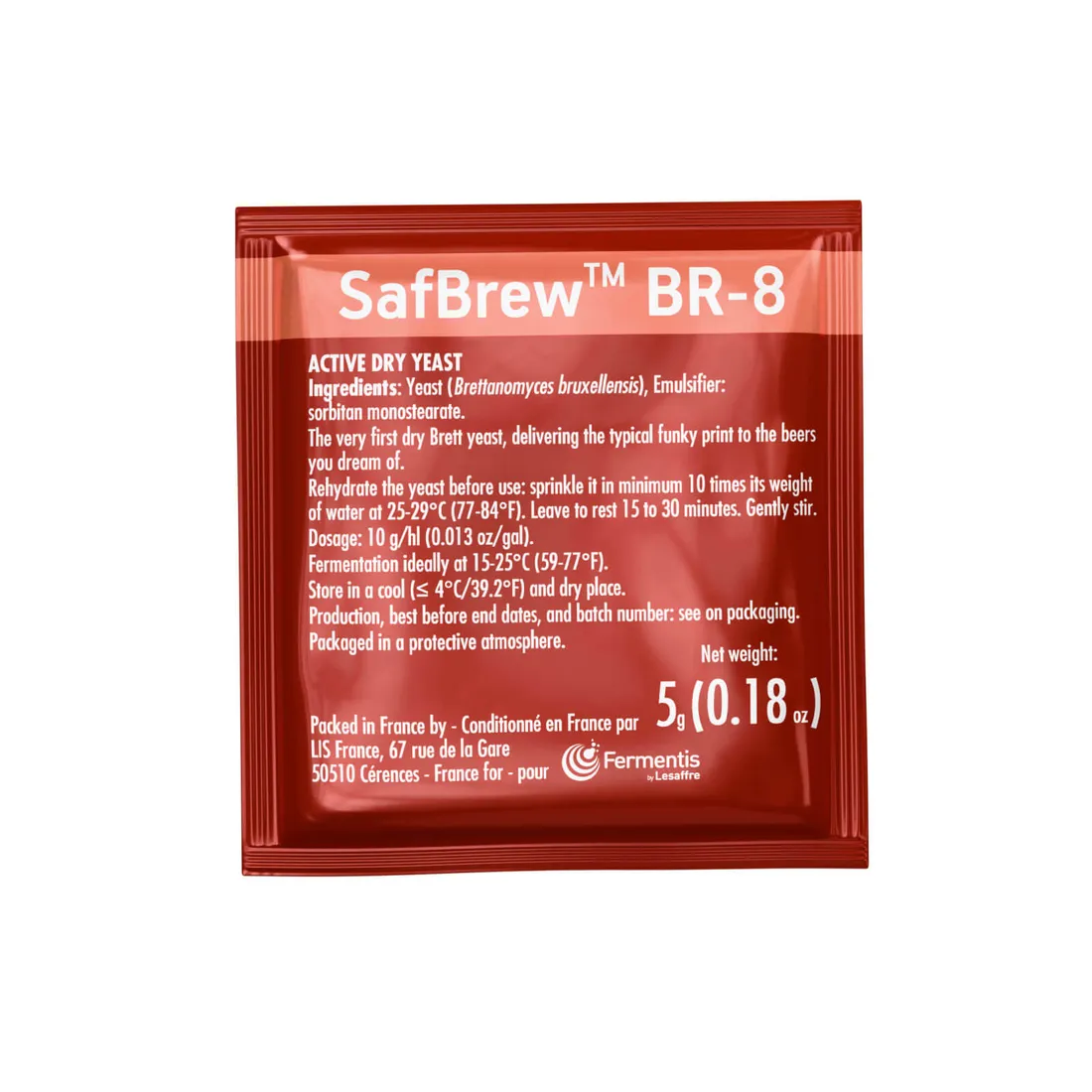


SafBrew™ BR-8 is the first Brettanomyces bruxellensis yeast available to brewers in a dry microgranular format.
It offers all the flavor benefits of ‘wild’ Brett yeast, but with more control and reliability, eliminating the risk of over-carbonation and gushing after bottling.
Selected specifically for secondary fermentation in bottles or casks, SafBrew™ BR-8 produces phenolic compounds that create a distinctive finishing touch which evolves over time as the beer is aged, with funkier notes (barnyard, horse, leather…) nicely balanced by refreshing, fruity notes.
Sensory Profile
SafBrew™ BR-8 produces phenolic compounds that create a distinctive finishing touch which evolves over time as the beer is aged, with funkier notes (barnyard, horse, leather…) nicely balanced by refreshing, fruity notes.
Usage
The primary fermentation is very important to allow the typical funky flavors of SafBrew™ BR-8 to develop correctly. We recommend using a maltotriose-positive yeast (a yeast strain able to assimilate maltotriose), otherwise, the residual sugars concentration would be too high at the end of the primary fermentation.
Optimal fermentation temperature 15°C – 25°C (59°F – 77°F).
Rehydratation: SafBrew™ BR-8 should not be rehydrated directly in the beer.
Sprinkle the yeast in minimum 10 times its weight of sterile water at a temperature of 25°C to 29°C (77°F to 84.2°F). Leave to rest 15 to 30 minutes. Gently stir until obtaining a yeast cream.
Usage: Add 5 to 10 grams of sugar per liter of beer (0.67 to 1.34 oz of sugar per gal of beer) to obtain an additional saturation of 2.5 to 5.0 g/L of CO2 (0.33 to 0.67 oz/gal of CO2). Pitch the sweetened beer at fermentation temperature with the rehydrated yeast.
Carbonation will be achieved in 1 to 3 months of maturation.
*At the end of refermentation, the beer can be cooled down and will gain in roundness after 2 to 3 weeks.
*Carbonation at lower end temperatures (e.g. 15°C / 59°F) can take over 3 months.